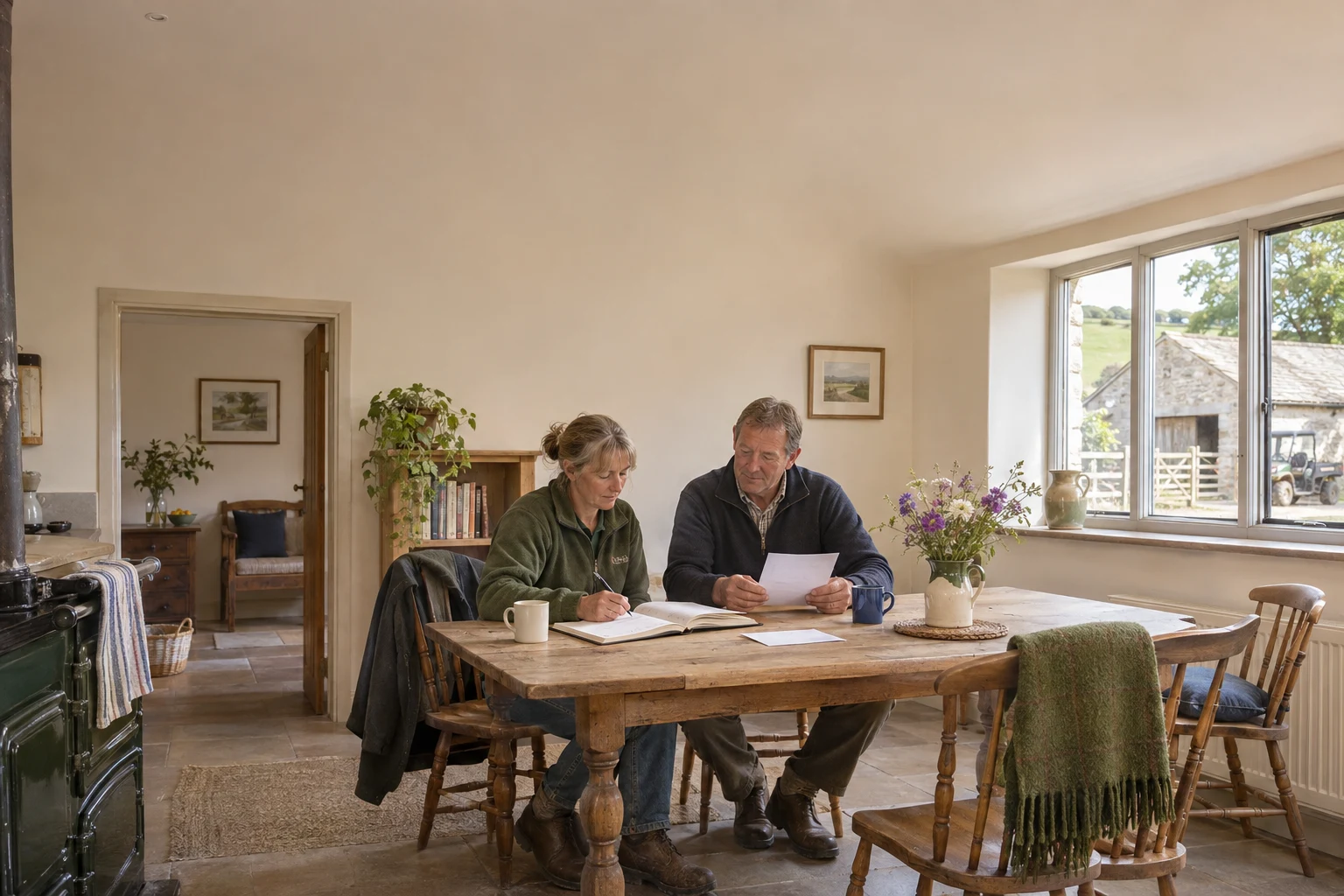

Owning your rural home does not automatically rule out Council Tax Reduction. GOV.UK says you can apply whether you own or rent, and whether you are working or unemployed; eligibility depends on your circumstances and the scheme where you live.[1]
For a farming family or someone running a business from home, start with a question to the council rather than assuming the property settles it. This is general information and signposting, not individual benefits, legal or financial advice. The application details below focus on England, with separate routes for the other UK nations.
Start with the household bill
Find the latest Council Tax bill and check the address, account reference and council named on it. If your home and business paperwork share a kitchen drawer, put the household bill beside you before calling. This article concerns help with that bill, not an assessment of farm or business rates.
GOV.UK says the assessment takes account of household income, savings, pensions, a partner’s income and other people living with you.[1] Do not try to predict the answer from the size of the house, a neighbour’s award or one difficult month.
Ask the council which scheme applies to your household. In England, Citizens Advice explains that working-age and pension-age rules differ, and that some benefits can affect which rules apply even after State Pension age.[2] Tell the council about both partners rather than choosing a form on age alone.
Explain the income pattern, not just the quiet week
Before making contact, gather the income records you already have. For someone with seasonal farm receipts, holiday-let work or irregular rural contracts, it may help to write down when money arrives and what period each record covers. Keep household and business documents clearly labelled.
Ask specifically what evidence the council needs for self-employment, variable income, savings and anyone else in the household. Ask which dates it wants covered. Do not assume last year’s accounts, a bank balance or a Universal Credit statement will answer every question.
Citizens Advice says the council’s website should explain the evidence required, such as proof of income and savings.[2] Use that request to build your paperwork pack. If a document is unclear, take the question to an adviser rather than altering the figures to fit a box.
Make the application without losing track of evidence
In England, you can apply using a form or online, and some councils also accept telephone applications.[2] If your broadband drops during forms or you cannot upload a document, ask the council which supported route is available. Keep a copy or confirmation of whatever you submit.
Citizens Advice recommends applying as soon as you can if eligible.[2] If you need longer to gather evidence, its guidance says to write “evidence to follow” on the application form and send it promptly.[2] Ask how to provide the missing documents securely, and note the deadline given to you.
If the council asks for more evidence after you apply, Citizens Advice says you should normally send it within a month, and tell the council if you cannot obtain it or need more time.[2] Put the request somewhere you will see it, not underneath the next delivery note.
Use the route for your UK nation
In Wales, the Welsh Government says low-income households may qualify for help through the Council Tax Reduction Scheme, including people in work. Contact your local authority to have your circumstances assessed.[4]
In Scotland, mygov.scot describes a means-tested Council Tax Reduction Scheme managed by local councils. Household income, savings and other circumstances are checked, so use the Scottish guidance and your council’s application route.[6]
Northern Ireland uses domestic rates rather than this Council Tax application route. Nidirect explains help for people on low incomes, including Rate Rebate for eligible Universal Credit recipients and Housing Benefit and Rate Relief routes.[7] Follow that guidance rather than sending an English Council Tax form.
Check the decision and the next payment
When the council has the information it needs, Citizens Advice says it should issue a written decision. If the decision is unclear, ask the council to explain it promptly.[2] Keep the decision with your application copy and ask what your remaining bill and payment dates are.
If you were eligible before applying, ask whether backdating is possible. In England, the rules differ between working-age and pension-age claims; backdating is not something to assume.[2] Give the council the relevant dates and ask what evidence it wants.
If the bill is still unaffordable, Citizens Advice explains that you can ask an English council about a discretionary reduction, whether or not you receive Council Tax Reduction.[2] Ask about that separately, without treating an application as a promised award.
For today, find the bill, identify your council’s application route and write down the evidence question you need answered. For more practical reading about farming and rural households, visit the Rural Mind hub.
Sources
[1] Apply for Council Tax Reduction
[2] Applying for Council Tax Reduction
[4] Council Tax discounts, disregards, exemptions and reductions | GOV.WALES
[6] Council Tax discounts, exemptions and reductions – mygov.scot